Is it legal to leave furniture on the pavement in Brussels?
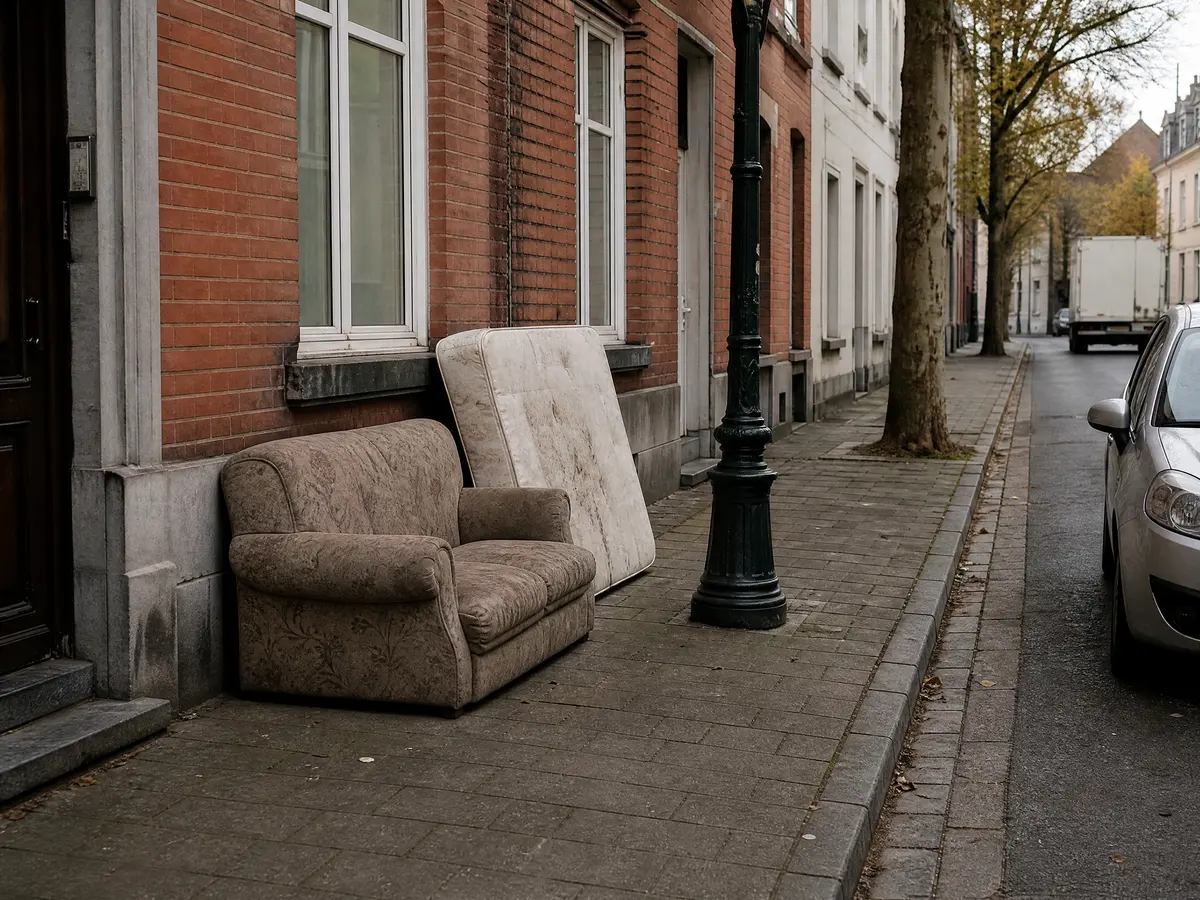
No. Furniture on the pavement outside an official collection is illegal dumping. Brussels Environment states that it is strictly prohibited to abandon waste in a public or private place outside authorised spots, and an old armchair on the kerb is exactly that.
The consequences go beyond a fine. Bruxelles-Propreté removes and treats abandoned waste automatically, at the expense of the person who left it, or of the occupant or owner of the premises. So the cost can land on whoever dumped the item, on you as the occupant, or on your landlord as the owner.
'Take me' furniture on the street in Brussels
We found no official exception for furniture put out with a 'take me' or 'help yourself' note. The rule is about abandoning waste outside authorised spots, and a chair that nobody takes is still abandoned. If someone wants the piece, hand it over in person; if not, have it collected from inside your home.
What 'dépôt clandestin' and 'sluikstort' mean
Dépôt clandestin (French) and sluikstort (Dutch) both mean illegal dumping: leaving waste somewhere it is not allowed, outside any authorised spot. You will meet both words in official texts, and the Dutch verb is sluikstorten.
Typical examples are a mattress propped against a tree, a broken fridge beside a public bin or bags of rubble at a street corner. Bruxelles-Propreté lists illegal dumping among the offences it sanctions, next to bags put out at the wrong time, unsorted bags and 'waste tourism', meaning waste brought in from the other two regions. Our guide to how bin bags and PMD work in Brussels shows which bag is for what and when it goes out.
The same list includes the illegal collection of waste on the regional territory. If you pay someone to take your items away, ask what happens to them afterwards: a sofa that ends up in another street is still a dumped sofa. Everything we collect is sorted for reuse and recycling, and nothing is dumped illegally.
How much the fine for illegal dumping is in the Brussels Region
Across the Brussels-Capital Region, waste offences under the Environmental Inspection Code are punishable by administrative fines of €50 to €62,500, with amounts set by the ordinance of 25 March 1999. Bruxelles-Propreté does not publish a fixed regional amount per m³ for illegal dumping, so the figure depends on the case.
The agency's sworn officers patrol seven days a week, 24 hours a day, and send every report (procès-verbal) to the public prosecutor. The prosecutor either prosecutes or sends the case back for an administrative fine, and removal costs can be added. For smaller offences, Bruxelles-Propreté's page on fines (opens in a new tab) publishes indicative amounts:
| Offence (Brussels Region) | Indicative fine |
|---|---|
| Unsorted bag containing glass | around €100–125 |
| Bags out outside the permitted hours | €50–75 |
| Breach of the bag collection calendar | between €50 and €200, excluding costs |
| Cigarette butts | €50 |
Administrative settlement for waste offences
An administrative settlement (transaction administrative) was introduced on 1 June 2023 and extended to sorting offences on 1 September 2024, at amounts of up to €350, paid by bank transfer within 2 weeks. Its extension to illegal dumping was only 'being examined' in 2024.
Illegal dumping tax in the City of Brussels since 1 August 2026
On the territory of the City of Brussels, meaning postcodes 1000, 1020, 1120 and 1130, a tax on incivilities (taxe sur les incivilités) applies since 1 August 2026, with fixed rates. These rates are the City's own and do not apply in the other 18 communes, where the regional fines and any commune rules apply instead. The full rules are on the City of Brussels incivilities page (opens in a new tab), and the areas that belong to the City are listed under Brussels City on our communes page.
| Incivility in the City of Brussels | Tax |
|---|---|
| Dumping or abandoning bulky items | €1,000 per m³ |
| Dumping or abandoning construction waste or hazardous waste | €2,000 per m³ |
| Using an unauthorised (non-official) bag | €400 per bag |
| Authorised bag or cardboard outside the collection place or hours | €200 per bag or per m³ of cardboard |
| Container outside the collection place or hours | €200 per container per day |
| Offence committed in a green space | amount doubled |
What the City of Brussels rates mean in practice
The tax is charged per m³, so every cubic metre of dumped furniture in Laeken, Haren or the Pentagon adds €1,000. Bags of tiles or plaster count as construction waste at €2,000 per m³, and leaving waste in a park doubles the amount. More than 100 sworn officers enforce the tax, and the City issued 7,731 cleanliness taxes in 2025.
How illegal dumping is detected in Brussels
Illegal dumping is picked up by patrols and by searching the dumped waste for clues about who left it. Bruxelles-Propreté's officers work around the clock, and Koekelberg says its agents search dumped waste to identify those responsible.
Koekelberg also gives a commune-level penalty: an administrative fine of up to €500, plus the cost of restoring the public space. Dumping waste and then asking the commune to remove it is forbidden there too.
How to get rid of bulky items in Brussels without risking a fine
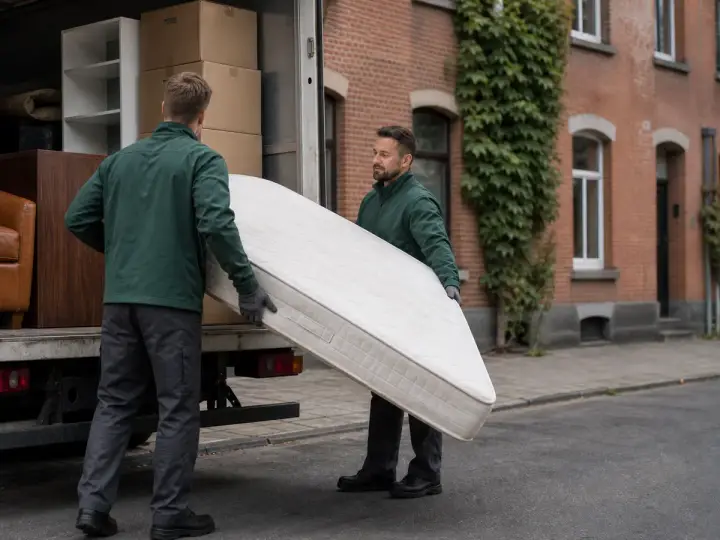
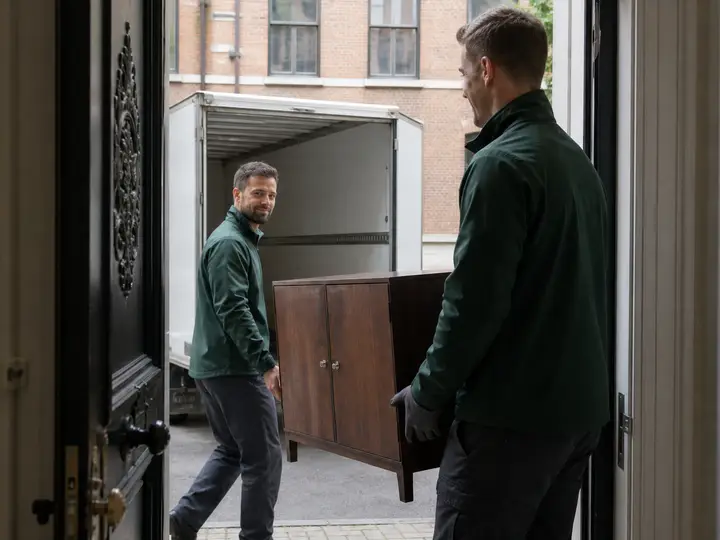
The safe way to empty a flat, a cellar or a house full of furniture is to have it carried out from inside, so nothing ever stands on the street. That is our service: you send photos and your commune, you get a fixed price, and a two-person crew comes with a box truck at an agreed time and carries everything out. See how our bulky waste collection works.
The price is set from the photos and nothing is added on the day. A small clearance such as a cellar or a room's worth is usually €250–600, and a whole apartment or terraced house €800–1,550. The price includes the crew, the carrying, the truck and the disposal fees; our prices page explains what moves it. Dumping is most common on moving day, and our page on clearing a flat at the end of a lease covers that case.
| What changes | Left on the pavement | Collected from inside your home |
|---|---|---|
| Legal status | Illegal dumping outside an official collection | Legal |
| Cost | Regional fines of €50 to €62,500, or €1,000 per m³ in the City of Brussels, plus removal costs | A fixed price agreed before the job, from €250 for a small clearance |
| Who carries | You, down the stairs | A two-person crew, out of your home |
| Where it ends up | Removed by Bruxelles-Propreté at the expense of whoever is held responsible | Sorted for reuse and recycling |
What we clear, and what we don't
We clear the contents of homes and offices: furniture, mattresses, appliances such as fridges and washing machines, household clutter and office furniture; see house clearance in Brussels for the most common job. We do not take garden waste, construction debris, asbestos, hazardous chemicals, gas bottles or clinical waste. Whatever the commune, the crew works the same way; the communes page covers all 19.
Frequently asked questions
Can I leave furniture on the street in Brussels?
No. Furniture on the pavement outside an official collection counts as illegal dumping, with regional fines from €50 to €62,500 and €1,000 per m³ in the City of Brussels. The safe option is to have it collected from inside your home.
What is the fine for dumping a mattress in Brussels?
In the City of Brussels, dumping bulky items such as a mattress is taxed at €1,000 per m³ since 1 August 2026. Elsewhere in the region, administrative fines range from €50 to €62,500, and removal and treatment costs can be added. Koekelberg, for example, mentions a fine of up to €500 plus the cost of restoring the public space.
Can I put old furniture next to a public bin in Brussels?
No. A public bin is not an authorised spot for bulky waste, and even official bags may not be placed next to public bins. Bruxelles-Propreté removes waste left there at the expense of whoever left it.
Who pays if furniture is dumped in front of my building?
According to Brussels Environment, Bruxelles-Propreté removes abandoned waste at the expense of the person who left it, or of the occupant or owner of the premises. If you know who dumped it, that matters, because agents do look for the person responsible.
How do I get rid of a sofa in Brussels without a fine?
Never put it on the pavement. If you have a car, take it to a Recypark yourself. If the sofa is part of a bigger clear-out, such as a move or a cellar, our crew carries it out with the rest, at a fixed price from photos; we do not come out for a single sofa on its own.
What does sluikstorten mean?
Sluikstorten is the Dutch word for dumping waste illegally, and a sluikstort is a dumped pile of waste. The French term is dépôt clandestin. In Brussels both words cover any waste left outside an authorised spot.
Official sources for this page
- arp-gan.be/fr/les-amendes
- arp-gan.be/fr/faq
- arp-gan.be/fr/actualites/un-traitement-plus-rapide-des-infractions-relatives-aux-dechets
- bruxelles.be/lutte-contre-les-incivilites
- environnement.brussels/citoyen/reglementation-et-inspection/obligations-et-autorisations/tri-des-dechets-quelles-sont-vos-obligations
- koekelberg.be/w/index.php?cont=2924&lgn=1
Last verified: