Who handles waste in Brussels
Household waste in the Brussels-Capital Region is handled by Bruxelles-Propreté, a regional public agency, not by your landlord or your building manager. Its full name is Agence Régionale pour la Propreté, its Dutch name is Net Brussel, and its website and letters often use the short form ARP-GAN.
Bruxelles-Propreté collects the colour-coded bags and runs the 6 Recyparks, and its sworn officers enforce the rules. Brussels Environment (Bruxelles Environnement / Leefmilieu Brussel) publishes the sorting obligations and handles awkward waste such as asbestos or gas bottles on 02/775 75 75.
Bulky Waste Brussels is not part of either. We are an independent company that clears homes, cellars and offices, carrying everything out at a price fixed before the job.
Brussels bin bag colours explained
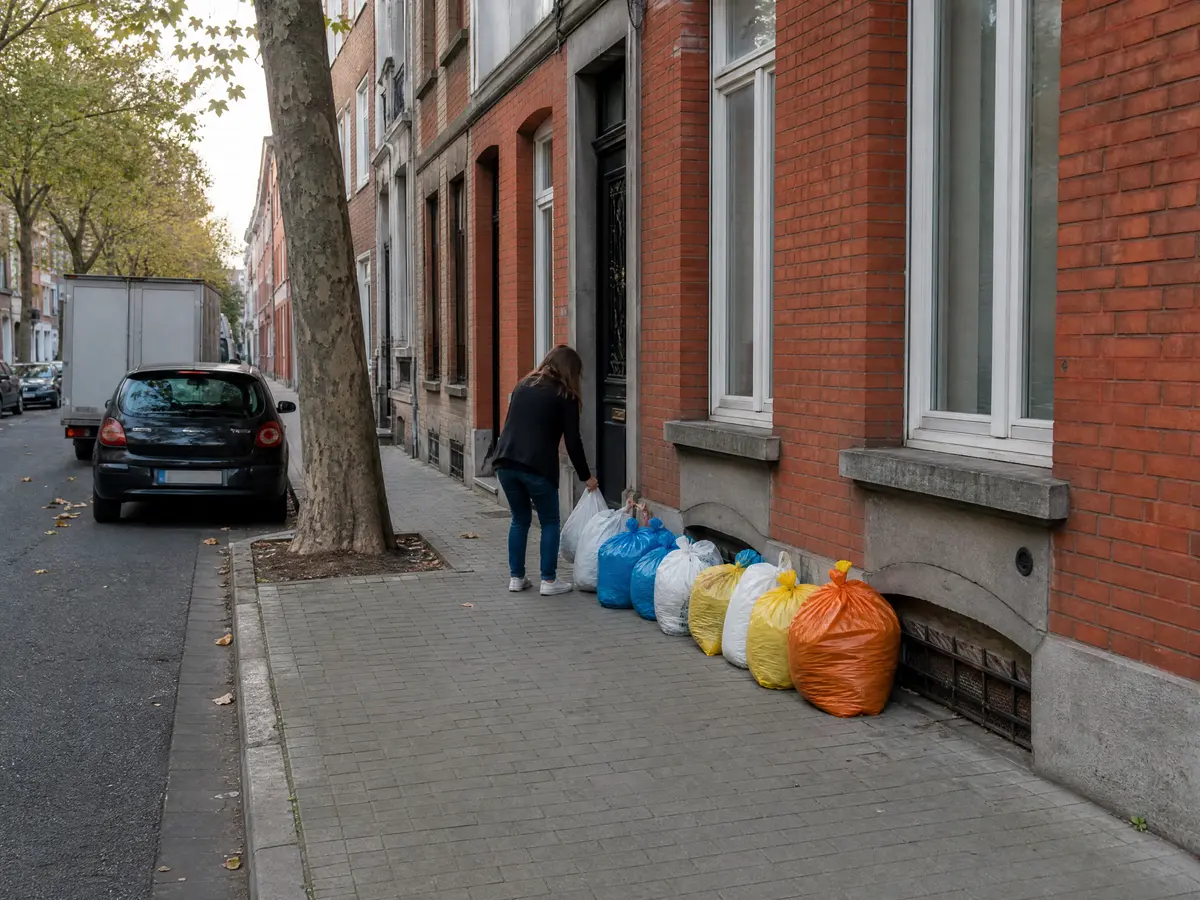
Brussels sorts household waste into five colours of official bag, each meant for one type of waste. The bags are sold in supermarkets, DIY stores and local shops, and only official Bruxelles-Propreté bags may be used. Each bag may weigh at most 15 kg.
On collection day, put your bags along the façade of your building, not at the foot of a tree or next to a public bin.
| Bag colour | What goes in it | Sizes | Recommended price per roll |
|---|---|---|---|
| White | Residual waste: whatever cannot be recycled | 30 L / 60 L | €1.50 / €2.50 for 15 bags |
| Blue | PMC packaging (PMD in Dutch) | 50 L / 100 L | €1.50 / €3.00 for 15 bags |
| Yellow | Paper and cardboard, or a tied bundle | 30 L | €1.50 for 15 bags |
| Orange | Food waste, compulsory since 15 May 2023 | 30 L | €1.25 for 15 bags |
| Green | Garden waste | 60 L | €2.50 for 10 bags |
Why black bin bags are not allowed in Brussels
Plain black or supermarket bin bags are not allowed because only official Bruxelles-Propreté bags may go out for collection. In the City of Brussels, a non-official bag has been taxed at €400 per bag since 1 August 2026. In the rest of the region, non-compliant bags fall under the regional fines explained on our page about fines for illegal dumping in Brussels.
Glass bottles and jars: bottle banks, not bags
Glass bottles and jars go in a bottle bank, white for clear glass and green for coloured glass. Use them only between 7:00 and 22:00, and if one is full, try another of the more than 560 sites. Flat glass, such as a cracked mirror or a window pane, never goes in a bottle bank.
What PMD means in Belgium
PMD is the Dutch abbreviation for the packaging that goes in the blue bag: Plastic, Metaal and Drankkartons, meaning plastic packaging, metal packaging and drink cartons. In French the same stream is called PMC (plastiques, métaux et cartons à boissons), which is the term Bruxelles-Propreté uses on its French pages.
So PMD and PMC mean the same blue bag. For the exact list of what it accepts, check the Bruxelles-Propreté page on bag collection (opens in a new tab). Hard plastics such as a cracked flower pot, and non-food packaging polystyrene from a new television, go to a Recypark instead.
Brussels bin collection days and times
Collection days are not the same everywhere in the region, so check the days for your own street instead of copying a friend's schedule from another commune. Bruxelles-Propreté answers questions on 0800 981 81, Monday to Friday 8:30–16:00.
The hour matters as much as the day. For evening collections, bags go out between 18:00 and 20:00. Bags put out at the wrong time bring indicative fines of €50–75, and the Bruxelles-Propreté FAQ puts breaches of the bag calendar between €50 and €200, excluding costs.
Bulky waste in Brussels: what doesn't fit in a bag
Bulky waste is household waste that cannot go in a bag because of its nature, weight or size, and that is not attached to the dwelling. By Bruxelles-Propreté's own definition, that covers a three-seater sofa, a box spring, a wardrobe taken apart, a fridge, a bike or a pram. A washbasin or bags of tiles from a bathroom job are construction and renovation waste, a separate category.
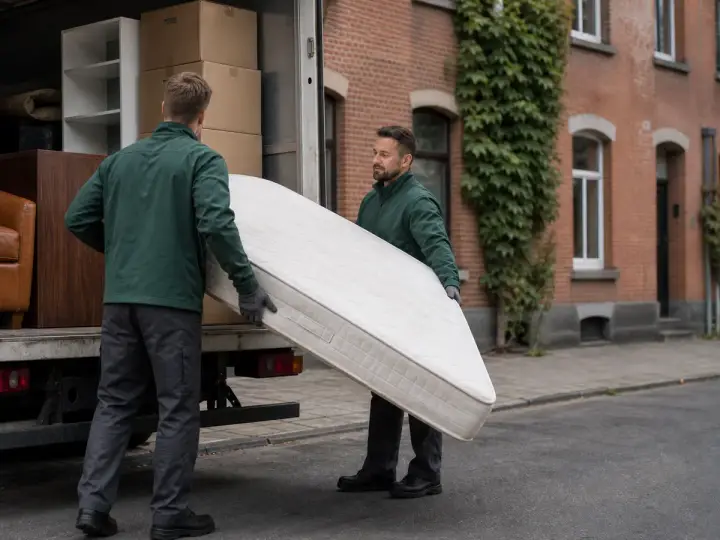
The white bag explicitly refuses bulky waste, mattresses and electrical equipment, so never force a broken chair into it. Bulky items may not go on the pavement either: outside an official collection, that counts as illegal dumping. When a whole flat, cellar or house has to be emptied, the practical answer is to have it cleared from inside, which is what we do:
- Send photos of the items and tell us your commune.
- Get a fixed price before anything is collected: a small clearance such as a cellar or a room's worth is usually €250–600, a studio or small flat €250–900. See bulky waste collection prices in Brussels.
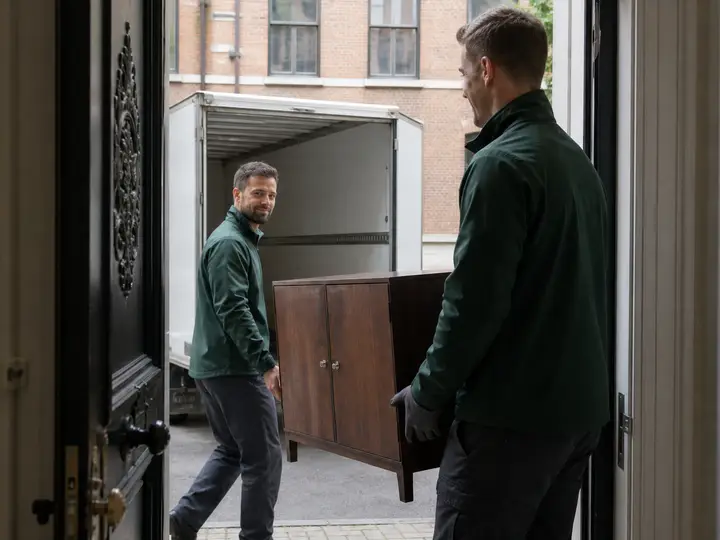
- A two-person crew comes with a box truck at an agreed time, carries everything out and loads it. Read how our bulky waste collection works.
- Sorting: usable furniture goes to reuse, appliances to electrical recycling, and wood, metal and cardboard to the right streams. Emptying an entire flat or house is covered on our house clearance in Brussels page.
Taking bulky waste to a Recypark yourself
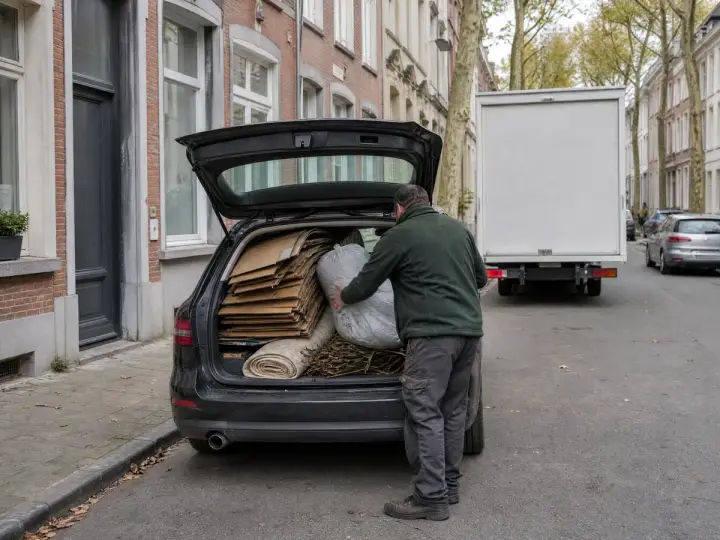
If you have a car and time, the Recyparks are the other legal route. Buda, Demets, Humanité and Sud take up to 3 m³ of sorted waste per day, with your identity card and a bank card, as cash is not accepted. Our guide to Recyparks in Brussels lists hours and rules for each site.
Chemical, electrical and garden waste in Brussels
Three kinds of household waste have their own channels in Brussels, because they do not belong in the white bag.
Electrical appliances, from a kettle to a chest freezer, go to a Recypark, a Recupel collection point, or back to the shop when you buy a new appliance of the same type. Large appliances are part of every flat we clear; see clearing a flat when you move out of Brussels. Household chemicals such as leftover paint or frying oil go to a Recypark, within set limits per visit; we do not take them. Garden waste goes in the green bag, and branches tied in bundles can go to a Recypark; garden waste is not something we take. Medicines go back to a pharmacy, and batteries go to a Bebat point or a Recypark.
Brussels waste vocabulary: French, Dutch and English
Official websites, letters and forms about waste in Brussels are mostly in French and Dutch. This table gives the terms you will meet most often, with their English meaning.
| English | French | Dutch |
|---|---|---|
| Bulky waste | encombrants | grofvuil (grof huisvuil) |
| Bulky waste collection | enlèvement des encombrants | ophaling grofvuil |
| Recycling centre, container park | Recypark, déchetterie, parc à conteneurs | Recypark, containerpark |
| Regional cleanliness agency | Bruxelles-Propreté (ARP) | Net Brussel (GAN) |
| Residual waste, white bag | ordures ménagères, sac blanc | restafval, witte zak |
| Packaging, blue bag | PMC, sac bleu | PMD, blauwe zak |
| Paper and cardboard, yellow bag | papier-carton, sac jaune | papier en karton, gele zak |
| Food waste, orange bag | déchets alimentaires, sac orange | voedingsafval, oranje zak |
| Garden waste, green bag | déchets de jardin, sac vert | tuinafval, groene zak |
| Bottle bank | bulle à verre | glasbol |
| Illegal dumping | dépôt clandestin | sluikstort |
| Exit inspection at the end of a lease | état des lieux de sortie | plaatsbeschrijving bij vertrek |
Rules for garbage disposal in Belgium vs Brussels
Belgium has no single national rulebook for household waste: the Brussels-Capital Region, Flanders and Wallonia each organise their own collection, with their own bags, container parks and fines. Everything on this site covers the Brussels-Capital Region only. In Leuven, Ghent or Namur the bags and container park rules can differ.
Bringing waste into Brussels from the other two regions is itself a fined offence ('waste tourism'), and the Recyparks only admit people domiciled in the Brussels-Capital Region, with Drogenbos residents as a limited exception at Humanité and Sud. Within Brussels, the correct way to dispose of garbage comes down to four habits:
- Sort household waste into the five official bags and put them out along the façade on your street's days.
- Take glass to a bottle bank and clean textiles to a clothing bank.
- Keep mattresses, appliances, tyres, batteries and oil out of the white bag.
- Leave no furniture on the pavement or beside a public bin; have bulky items collected from your home instead.
Frequently asked questions
What colour bag should I use for household waste in Brussels?
Use the white Bruxelles-Propreté bag for residual waste, meaning whatever cannot be recycled. Packaging goes in the blue bag, paper and cardboard in the yellow one, food waste in the orange one and garden waste in the green one. White bags come in 30 L and 60 L, and no bag may weigh more than 15 kg.
Can I use black bin bags in Brussels?
No. Only official Bruxelles-Propreté bags are allowed, so a plain black bag counts as non-compliant.
What is residual waste?
Residual waste is what remains once packaging, paper, food, garden waste, glass and anything a Recypark accepts have been sorted out. In Brussels it goes in the white bag, which refuses tyres, batteries, oils, medicines and clean textiles.
Is it okay to leave garbage on the street in Brussels?
Only official bags, on your collection day, along your façade and within the set hours. Anything else left in the street counts as abandoned waste, which Bruxelles-Propreté removes at the expense of whoever left it, and fines can follow.
How do I get rid of furniture in Brussels as an expat?
When you are emptying a flat or a house, have it cleared from inside. You send photos and your commune, get a fixed price in English, and a two-person crew carries everything out of the home. Small clearances start from €250.
Official sources for this page
- arp-gan.be/fr/collecte-en-sacs
- arp-gan.be/fr/dechet-tri?waste-type-id=27
- arp-gan.be/fr/dechet-tri?waste-type-id=34
- arp-gan.be/fr/les-amendes
- arp-gan.be/fr/faq
- arp-gan.be/fr/recypark
Last verified: